
Spiral Dynamics Explained: Understanding the Evolution of Human Consciousness
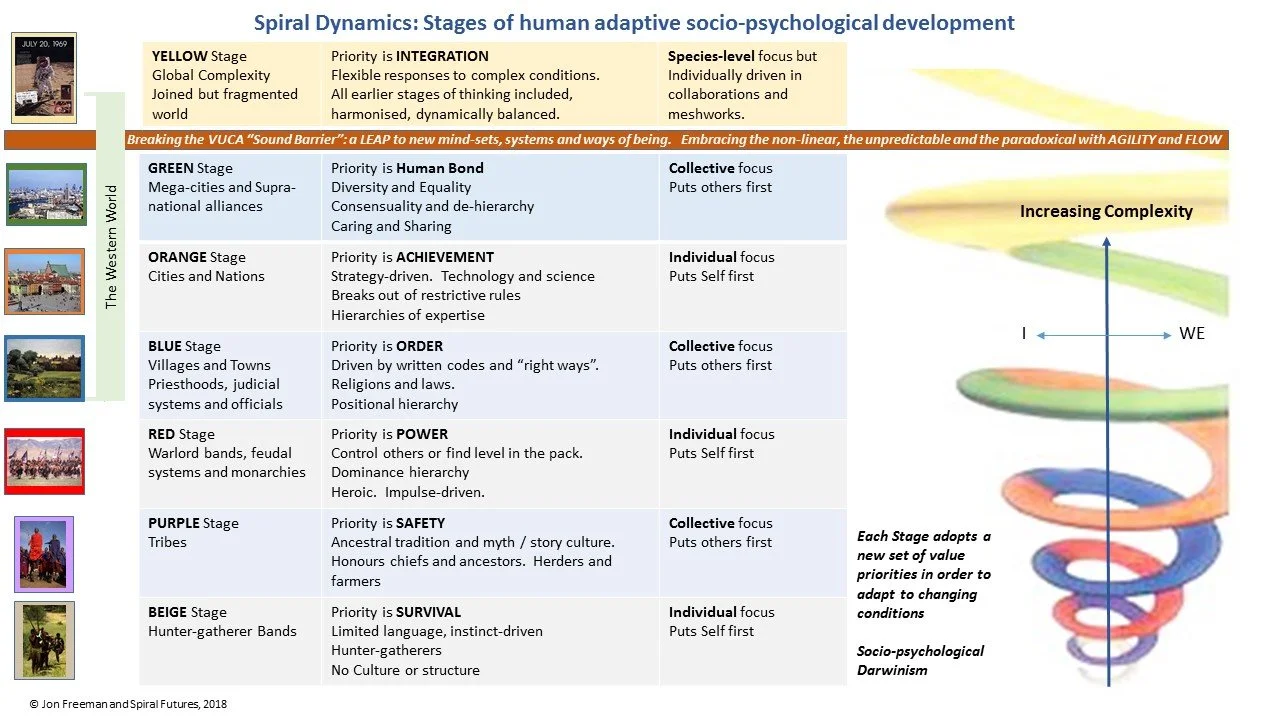
Great Chart, however, unfortunately is missing stage Turquoise– Holistic Unity, at the top.
You’ve probably heard the phrase, “We are all one.” It’s a compelling spiritual statement—but what does it actually mean in practical, psychological, and cultural terms? If humanity shares one underlying consciousness, why do we experience such profound division in politics, religion, economics, and identity?
On the surface, you are you and I am me—distinct individuals with different histories, values, and beliefs. Yet when we zoom out, patterns begin to emerge. Spiral Dynamics offers a developmental map that helps explain how both individuality and unity can coexist within an evolving system of human consciousness.
What Is Spiral Dynamics?
Spiral Dynamics is a model of human development and cultural evolution developed by Don Beck and Chris Cowan, building on the foundational research of psychologist Clare W. Graves. The model proposes that individuals and societies evolve through identifiable stages of increasing complexity in thinking, values, and behavior.
Rather than framing conflict as good versus bad, Spiral Dynamics suggests that people operate from distinct value systems shaped by life conditions. These value systems—sometimes called “memes”—act like psychological operating systems that influence how we interpret reality and organize society.
Human development unfolds in a spiral pattern, not a straight line. Movement through the stages is dynamic and responsive to internal growth and external pressures.
An interesting feature of the spiral is that these stages tend to oscillate between more individualistic and more collectivistic worldviews. One stage emphasizes autonomy and personal power; the next often re-centers around group cohesion and shared structure. This rhythm reflects an ongoing tension in human development between self-expression and belonging.
The Eight Value Systems
Spiral Dynamics identifies eight core stages of development:
Beige – Survival
Concerned with basic biological needs: food, safety, shelter. This stage is purely survival-oriented and appears in infancy or extreme conditions.
Purple – Tribal Belonging
Collectivistic and rooted in tradition, ritual, and magical thinking. Purple emphasizes loyalty to tribe, ancestors, and community.
Red – Power and Assertion
Individualistic and egocentric. Red asserts dominance and autonomy. It values strength and control.
Blue – Order and Authority
Collectivistic again. Blue prioritizes law, structure, religion, and moral codes. It stabilizes society through shared rules and duty.
Orange – Achievement and Rationality
Returns to individualism. Orange values success, progress, science, and capitalism. It drives innovation and self-improvement.
Green – Equality and Inclusion
Collectivistic and pluralistic. Green emphasizes empathy, diversity, environmentalism, and shared humanity, leaning more toward socialism.
Yellow – Integrative Systems Thinking
Marks the beginning of second-tier consciousness. Yellow is more flexible and systemic, integrating previous stages without rigid attachment. Systems thinking for conscious, heart-centered government based on universal Divine Love, with self-sovereignty, free association, and equal rights for all people on Earth in progression as each culture psychologically moves through these stages and naturally adopts similar values. Yellow sees the inherent values and flaws of both capitalism and socialism and organizes systems to devise solutions that contain the best of both, while keeping governments separate from the interests of both corporations and religious institutions, decentralized, transparent, and accountable to the people they serve, who vary in customs and moral codes from culture to culture.
Turquoise – Holistic Unity
A world-centric stage embodying unity consciousness. Turquoise experiences interconnectedness as lived reality rather than abstract belief.
First Tier and Second Tier
The first six stages—Beige through Green—are considered first-tier. In these stages, individuals tend to see their worldview as the only correct one and may judge and demonize others from different stages.
Second-tier stages—Yellow and Turquoise—represent a qualitative shift. Here, individuals recognize that each stage emerges to solve specific life conditions. Rather than demonizing other perspectives, second-tier thinking understands their function within the broader evolutionary system.
This shift dramatically reduces ideological conflict because it reframes disagreement as developmental difference rather than moral failure.
Why Conflict Happens
Because stages alternate between prioritizing the individual and prioritizing the collective, tensions naturally arise. Individualistic stages may perceive collectivistic stages as restrictive or naïve. Collectivistic stages may view individualistic ones as selfish or exploitative.
These clashes are not accidental. They reflect different strategies for organizing society and solving problems. Each stage responds to perceived shortcomings of the previous one.
For example:
Red emerges when tribal constraints feel limiting.
Blue emerges when unchecked power creates chaos.
Orange emerges when rigid authority suppresses innovation.
Green emerges when achievement-driven systems neglect empathy.
Yellow emerges when care for others becomes controlling and cancelling.
Understanding this developmental rhythm provides insight into political polarization, cultural shifts, and organizational friction.
Applications in the Real World
Spiral Dynamics is widely used in leadership development, organizational consulting, conflict resolution, and cultural analysis. It helps leaders:
Navigate value-based disagreements
Design systems that account for developmental diversity
Improve communication across worldviews
Facilitate long-term strategic change
By recognizing memetic codes, organizations can reduce misunderstanding and build more adaptive systems.
What This Means for Unity
If humanity is evolving through shared developmental stages, then “we are all one” takes on new meaning. Unity does not require sameness. It recognizes that individuals and cultures occupy different positions along the same spiral of growth.
Each stage contains both healthy and unhealthy expressions. No stage is inherently superior; each is necessary within the larger system. Problems arise when we become rigidly identified with one stage and reject the others.
True maturity involves expanding perspective—seeing that what appears irrational from one worldview may be entirely coherent from another.
Spiral Dynamics offers a map for that expansion. It does not eliminate disagreement. It contextualizes it.
And perhaps that is one grounded way to understand unity—not as the erasure of difference, but as the integration of difference within an evolving whole.
In relation to Periods of Art Pilosiphy
Purple – Tribal Belonging
Artistically, purple can be traced back to pictographs and ancient tribal art.
Red – Power and Assertion
Pre-Classical Art, as it pertains to personal strength and control or dominance over others, rather than reflecting values along the lines of of law and order or religious faith, etc.
Blue – Order and Authority
Classical and some Pre-Classical Art
Orange – Achievement and Rationality
Modernity and Modernism.
Green – Equality and Inclusion
Postmodernism and the Postmodern era.
**Metamodernism is a scam by fringe, far-left academic professors and parasitic elitist who themselves keep repeating stage Green with an ever increasing sense of self righteous moral superiority and justifications for control over others, not a true progression to stage Yellow.
Yellow – Integrative Systems Thinking
**Spiritual-Modernism seeks to represent tier two, stage Yellow at its birth within the individual person or community, as well as eventually representing Turquoise, as it emerges and expands upon a person’s or society's experiential depth of the mystical.
Turquoise – Holistic Unity
Also, I would argue that the Egyptian pyramids and various megalithic structures are stage Turquoise, if not Yellow, created from ancient civilizations who have been obfuscated in history books.
P.s. If you enjoyed this read, I recommend this article next:
Spiritually-Modern or Misfit Metamodern Artist: Pondering My Post-Postmodern Philosophy
Spiral Dynamics Explained by Leo Gura at Actualized.org YouTube
**author’s note
